

Why Two Median Home Prices Can Both Be Correct
If you follow real estate news, you've probably seen two reports covering the same month where the median prices don't match.
At first glance, it looks like someone got it wrong. That usually isn't the case—the reports are just measuring different groups of homes.
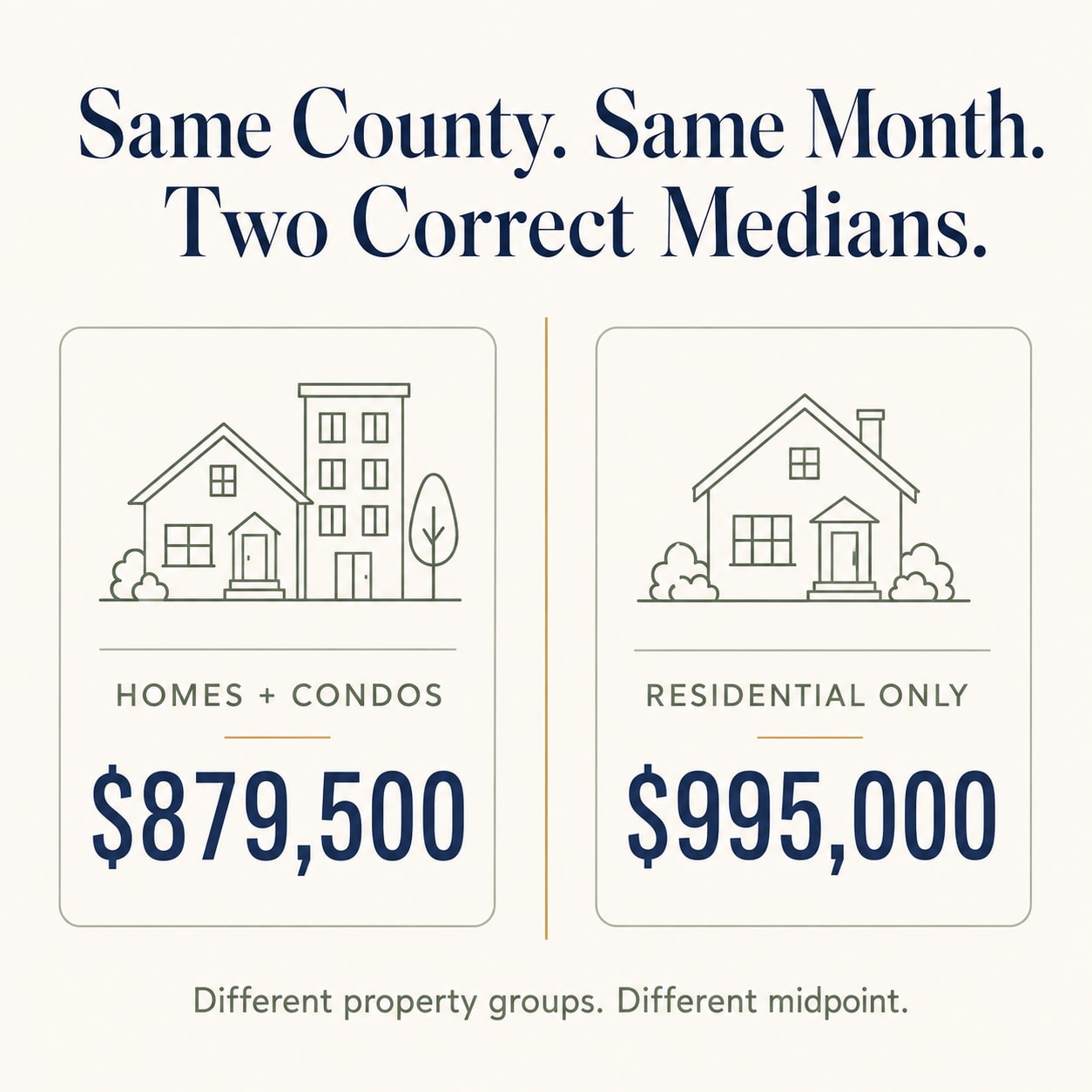
King County's July numbers are a clean example. Northwest MLS reported a median sale price of $879,500 with residential homes and condominiums combined. A separate residential-only report put the median at $995,000.
That's a $115,500 gap, same county, same month. Neither number is wrong. They're answering different questions.
Start With What the Report Includes
The combined figure includes detached homes, townhomes classified as residential, and condominiums. Condos generally sell for less than detached homes, so folding them in can pull the overall median down.
Pull the condo segment out, and you're looking at a different group of sales entirely—which means a different midpoint. That's the whole difference, right there.
This is why we care about the fine print around a statistic as much as the statistic itself. Before you compare two market reports, ask:
Which property types are included?
What geographic area is being measured?
Is this a median or an average?
Does it cover closed, pending, or active listings?
What time period is it using?
Change any one of those, and the number moves—sometimes by a lot.
What a Median Actually Tells You
A median is just the midpoint. Half the sales landed above it, half below.
It doesn't mean most homes sold at that exact number, and it tells you nothing about what any single property gained or lost. If more condos or entry-level homes happen to close in a given month, the countywide median can drop even while individual home values hold steady. If more luxury properties close the next month, the median can climb—without meaning every home became more valuable.
Sometimes a shifting median reflects real price movement. Other times, it reflects a shift in which homes happened to close that month. We've seen both play out, and they look identical in a headline.
Geography Changes the Story Too
"King County" covers an enormous range—Seattle condos, South King County starter homes, Eastside properties, waterfront estates. A countywide median blends all of it into a single number.
That's fine for spotting a broad trend. It tells you almost nothing about what a rambler in East Bellevue, a condo in Belltown, or a Craftsman near Green Lake is actually worth.
Even two reports that both say "Seattle" can be using different boundaries, different property types, or different price bands. The headline looks the same. The data underneath it isn't.
Closed, Pending, and Active Aren't Interchangeable
Status matters just as much as geography.
Closed prices are what buyers and sellers actually agreed to in deals that have already finished. Pending data is an earlier read on current agreements—real contracts, just not closed yet. Active-listing prices are what sellers are asking, not what anyone has agreed to pay.
Each one tells you something real. None of them measure the same thing, and comparing them directly will lead you astray.
The Right Number Depends on the Question
Want a broad read on the county? The combined median works fine for that.
Evaluating a detached home specifically? The residential-only median gets you closer—but it's still a starting point, not an answer.
For an actual buying, selling, or valuation decision, we narrow much further than either of those:
The immediate neighborhood
Property type and style
Condition and level of updating
Lot size and location
Price range
Recent comparable sales
Current competing listings
Buyer activity right now, at that price point
The more specific the decision, the more specific the data has to get. A countywide median was never built to answer, "What's my house worth?"
Read Past the Headline
The next time two reports show different medians for the same place, don't ask which one's wrong. Ask what each one actually included. Often, that single question explains the whole gap.
A countywide number is useful context. It's not a substitute for looking at your specific home, on your specific street, against what's actually selling around it right now—and that's the part we're glad to walk through with you anytime.
Sources: Northwest MLS July 2026 Market Snapshot and Windermere Bellevue August 2026 Local Market Update. Information and statistics compiled and reported by the Northwest Multiple Listing Service.