
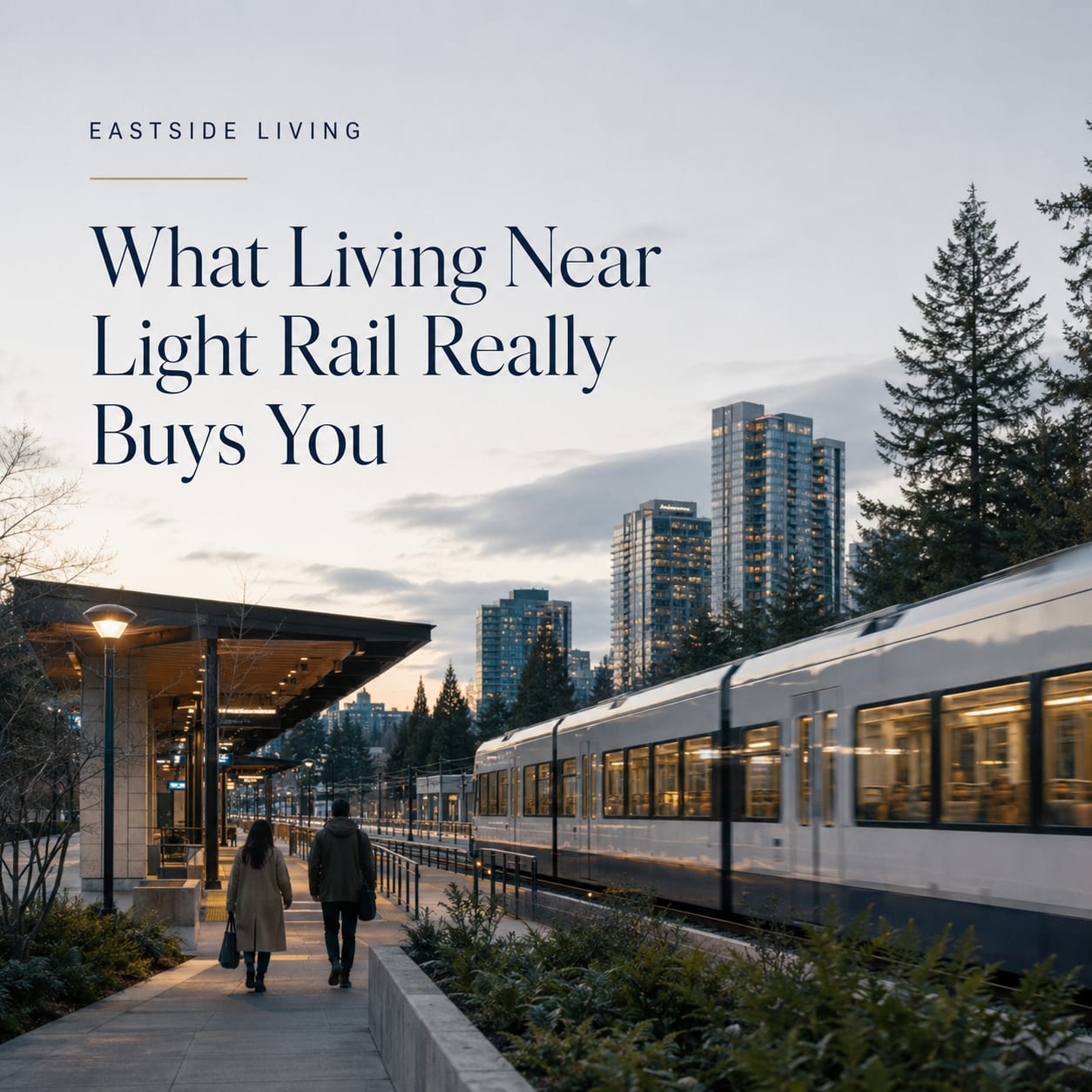

What Living Near Light Rail Really Buys You
This summer, the World Cup gave me a reason to go downtown more often than I usually do—and light rail made it easy. No bridge traffic. No circling for parking. Just a train that dropped me close to where I wanted to be.
It sounds like a small thing, but it changed how often I said yes to going.
And it’s not just a World Cup story. I have buyers right now who are specifically asking for homes near light rail—not as a nice-to-have, but as one of their top priorities.
For the Eastside, this isn’t hypothetical anymore.
On March 28, the 2 Line connection across Lake Washington opened, linking Redmond and Bellevue directly to downtown Seattle. A trip from Downtown Bellevue to the center of Seattle now takes roughly 25 minutes, without a transfer or building your plans around traffic on I-90 or 520.
If you live near South Bellevue, Downtown Bellevue, the BelRed corridor, Overlake, or Downtown Redmond, it’s now possible to leave the car at home for dinner, a game, an appointment, or an afternoon in Seattle—and simply go.
That’s what buyers are really asking for when they say they want to live near light rail. Not just access to a train, but a version of daily life that feels easier and more connected.
What that lifestyle actually looks like
It’s a weeknight dinner downtown without thinking about parking. A Sounders or Mariners game without planning the drive home. Visiting friends across the lake without watching the clock for rush hour.
None of those trips is life-changing on its own. But add them up over a year, and they can change how much of the region you actually use.
Why this matters when choosing a home
When a buyer tells me transit matters, I take it as seriously as square footage, layout, or school district—because it affects how they’ll live in the home, not just how they’ll commute from it.
Two houses can look nearly identical on paper, but if one is a comfortable walk from a station and the other requires a 25-minute drive to reach one, they offer two very different daily lives.
That’s worth thinking through before you fall for a listing.
If this is the lifestyle you’re picturing, here’s what I would look at:
- The actual walk to the station. “Close” on a map doesn’t account for hills, busy intersections, poor sidewalks, or what the walk feels like on a dark February evening.
- Service when you’ll really use it. Look beyond the morning commute. Check evening, weekend, and event-day frequency too.
- What else is within walking distance. A home near transit, restaurants, groceries, and everyday services can reduce how often you need the car—not just how you get to work.
The takeaway
The World Cup didn’t teach me anything new about transit. It simply made the benefit harder to ignore.
Now that the 2 Line connects the Eastside directly with Seattle, living near light rail can genuinely change how easily you move through the region. If that kind of flexibility is part of the life you’re picturing, it deserves a place near the top of your home-search criteria.
And we’d be happy to help you figure out which neighborhoods—and which stations—actually fit the way you want to live.