


Seattle’s Housing Market Didn’t Crash — Buyer Psychology Changed
For the past several years, real estate headlines have bounced between extremes.
One month the market was “out of control.”
The next month it was supposedly “cooling.”
Then came predictions of crashes, corrections, and collapses.
But after looking closely at both current Seattle sales activity and broader market trends from the past five years, the reality is much more nuanced:
Seattle’s housing market didn’t crash.
It became rational again.
And the biggest shift wasn’t inventory, rates, or pricing.
It was buyer psychology.
The Last Five Years Completely Changed Buyer Behavior
From 2020 through early 2022, Seattle experienced one of the most competitive housing environments we’ve ever seen.
Buyers were:
- waiving contingencies
- escalating aggressively
- competing against dozens of offers
- making decisions within hours
- prioritizing “winning” over evaluating
Fear of missing out drove the market.
And honestly, during that period, almost everything sold.
Homes that were overpriced still attracted offers. Homes with flaws still moved quickly. Sellers had enormous leverage simply because inventory was so limited.
But markets like that rarely last forever.
Today’s Buyers Are Thinking Differently
Fast forward to today, and we’re seeing a completely different mindset emerge.
Buyers haven’t disappeared. In fact, many homes are still receiving strong activity and multiple offers. But buyers have become far more intentional about where they’re willing to compete.
Instead of fearing they’ll miss out, many buyers now fear overpaying.
That psychological shift has changed the market dramatically.
Today’s buyers are:
- comparing inventory more carefully
- analyzing value more critically
- negotiating more strategically
- waiting longer before acting
- prioritizing condition, layout, and long-term livability
And the data is reflecting that shift clearly.
The First Week Has Become More Important Than Ever
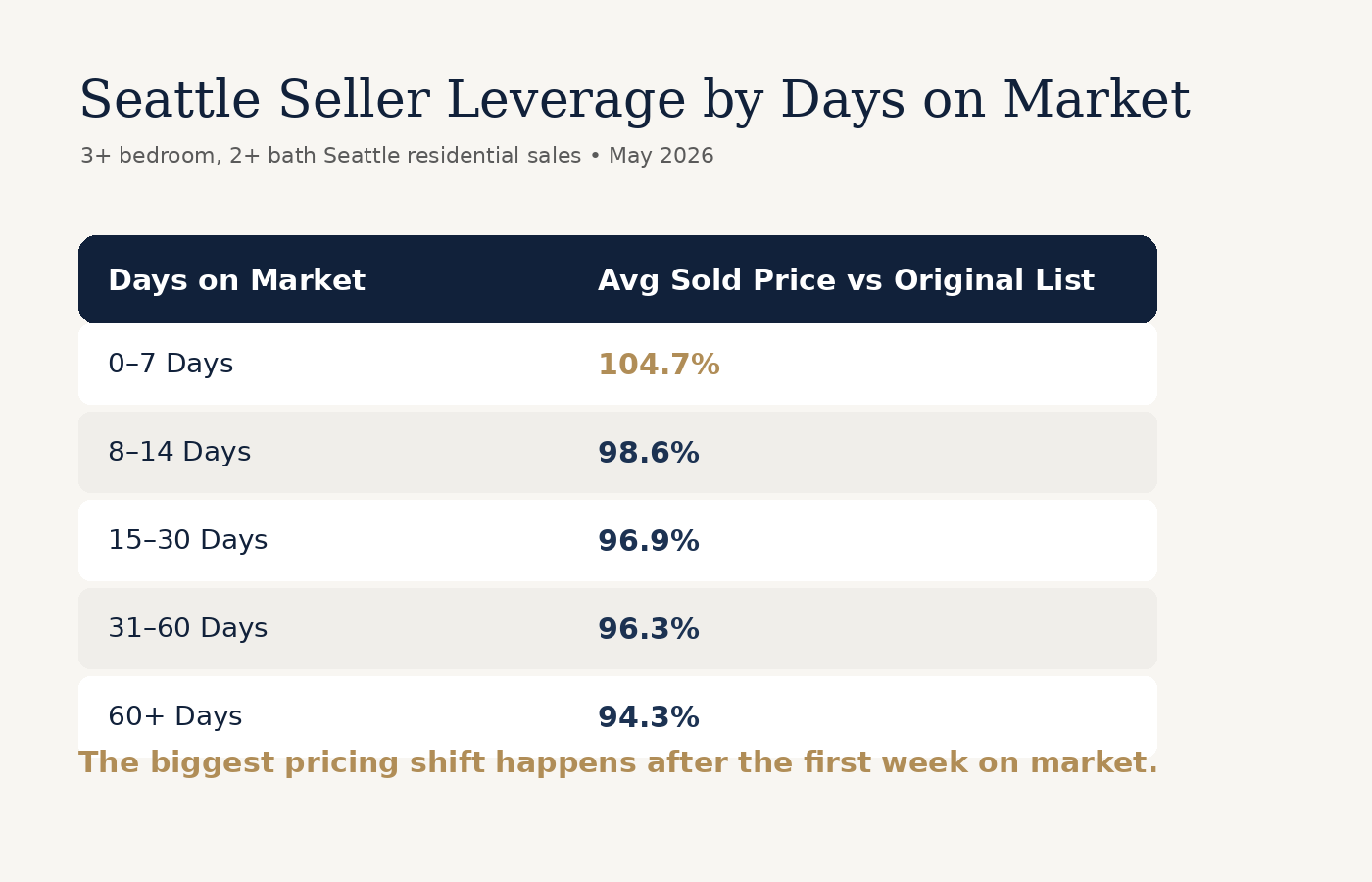
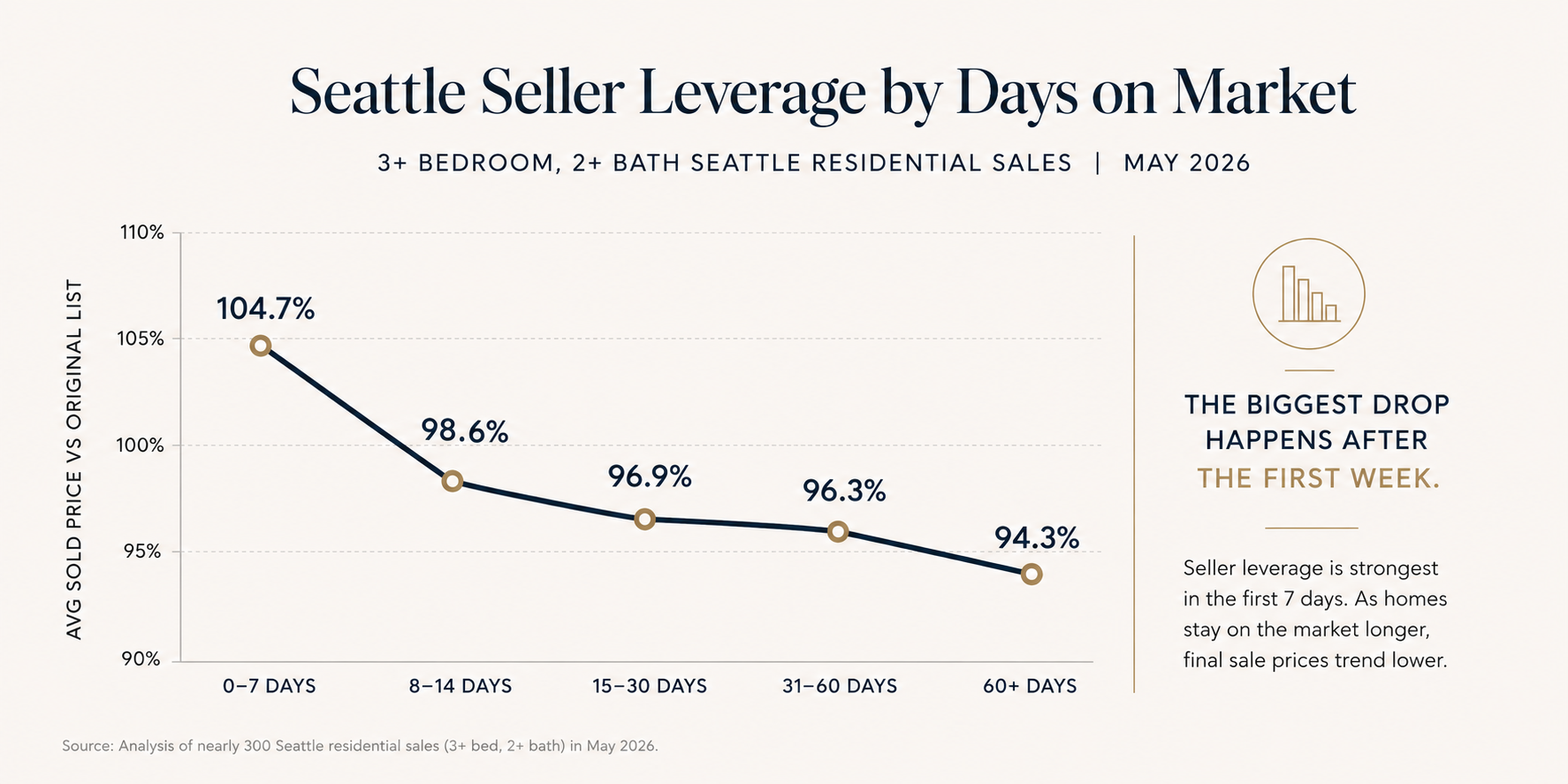
We recently analyzed nearly 300 Seattle home sales from the past month, focusing specifically on 3+ bedroom, 2+ bath residential homes across the city. One trend stood out immediately:
Homes that sold within the first week averaged over 104% of their original asking price. But once homes sat longer, seller leverage dropped quickly.
That tells us something important:
Seattle buyers are still willing to compete aggressively — but only when the value feels obvious immediately.
The market is no longer giving every listing a free pass.
Seattle Has Quietly Become Two Different Markets
One of the clearest themes emerging right now is that there isn’t just one Seattle housing market anymore.
There’s the market for:
- well-prepared
- strategically priced
- move-in-ready homes
And then there’s the market for homes that:
- feel overpriced
- missed the market initially
- need substantial work
- struggle to justify value against competing inventory
The difference in outcome between those two categories can be massive.
Some homes are still selling with multiple offers and premium pricing. Others are sitting for weeks or months before eventually reducing.
That split barely existed during the frenzy years.
Today, it’s defining the market.
This Is Actually a Healthier Market
Ironically, many of the things buyers and sellers are frustrated by right now are signs of a more balanced and sustainable housing market.
Pricing matters again.
Negotiation matters again.
Presentation matters again.
Strategy matters again.
And honestly, that’s healthier long term than a market where buyers feel forced to waive every protection just to compete.
The Seattle market still has strong demand, especially for desirable homes in strong locations. But the era of automatic appreciation and effortless leverage has evolved into something more disciplined.
Final Thoughts
The biggest real estate story over the past five years isn’t simply that rates changed or inventory increased.
It’s that buyer psychology fundamentally shifted.
Fear of missing out has slowly been replaced by fear of overpaying. And that single change is reshaping pricing strategy, negotiations, days on market, and seller expectations across Seattle.
The market didn’t crash.
It matured.
And increasingly, the sellers seeing the strongest outcomes are the ones who understand that difference first.