
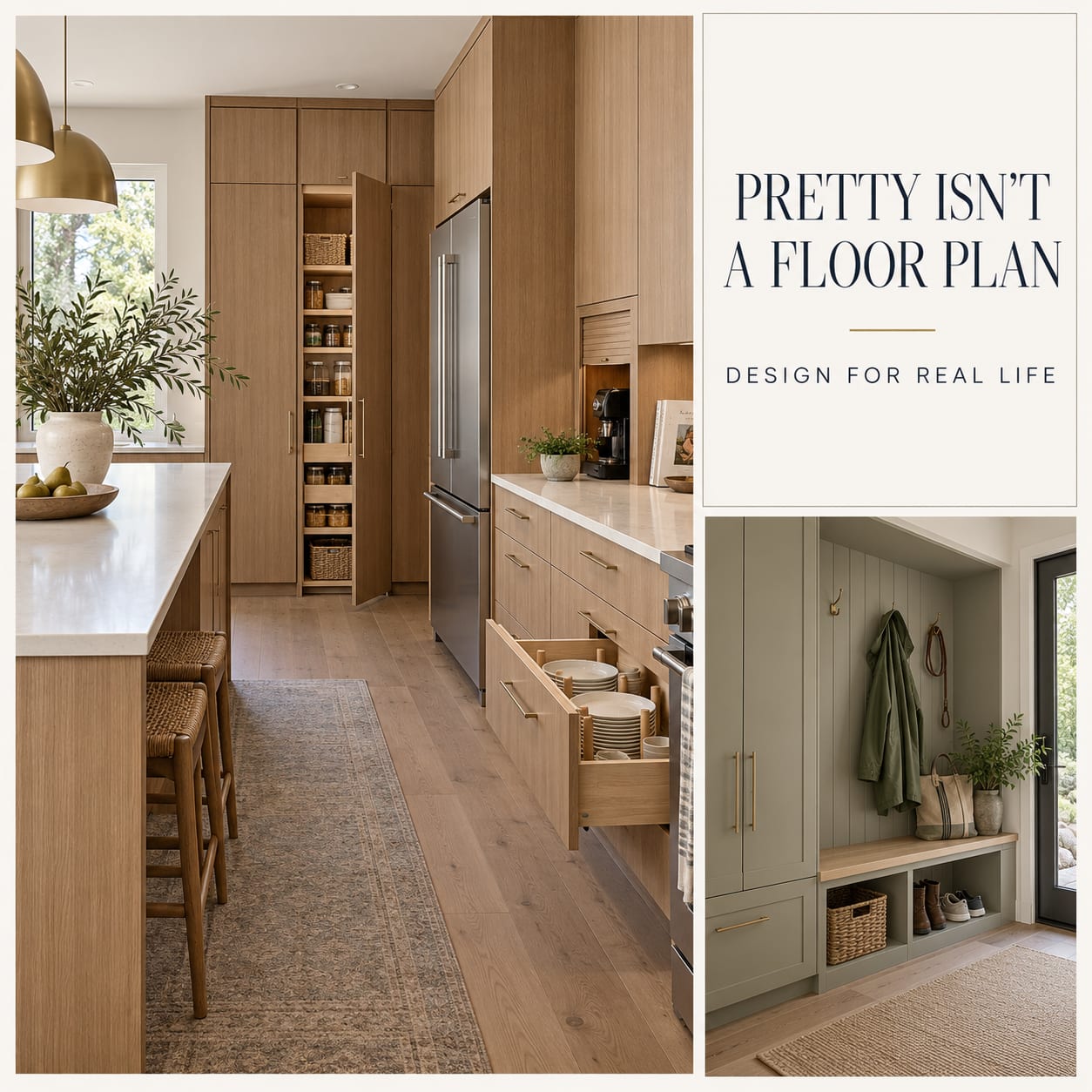

Pretty Isn’t a Floor Plan
It photographs beautifully. The counters gleam, the light pours in, and the rooms feel wide open.
Then you open the one cabinet next to the stove.
Where do the plates go? Where does the coffee maker sit without swallowing half the counter? Where do the vacuum, spare blankets, suitcases, sports gear, and that giant pack of paper towels live?
A home isn’t just something you look at. It’s something you use every day. The best design never forgets that.
Follow the Path From the Front Door
Before focusing on finishes, think through how you’d actually use the space.
Where do keys, mail, and backpacks land when you walk in? Is there a place for wet jackets and muddy shoes on a rainy morning? Can one person cook while another unloads the dishwasher? If you have a dog, where do the leash, food, and towels go?
An open floor plan can look impressive without being functional. We often see a slightly smaller room with good storage and easy circulation work far better than a larger one with awkward doorways, dead corners, and no clear place for furniture.
Look Past the Quartz
The kitchen is usually where the gap between attractive and functional shows up first.
New cabinets, stone counters, and statement lighting make a strong first impression. But once you start cooking, the layout matters more.
A few things worth checking:
- Are plates and glasses stored near the dishwasher?
- Is there real pantry space?
- Is there a practical home for small appliances?
- Are trash and recycling convenient to both prep and cleanup?
- Can the refrigerator, oven, and dishwasher open without blocking one another or the main walkway?
- Is there counter space to set things down beside major appliances?
Open shelving and minimal upper cabinets look beautiful in photos. They only work if there’s enough concealed storage somewhere else.
Storage in the Wrong Place Isn’t Useful Storage
Plenty of storage and useful storage aren’t the same thing.
A linen closet on the wrong floor doesn’t help when you need towels in the bathroom. Garage shelving doesn’t make up for a missing pantry. A generous bedroom closet doesn’t replace a place for coats and shoes by the door.
Think about what you reach for every day and where you naturally reach for it. The best storage supports the room it’s in, so you’re not carrying things from one end of the house to the other.
Add the Furniture—in Your Head
An empty room can hide problems that furniture reveals.
Where would the sofa go? Can you cross the room without walking between the television and the seating? Will dining chairs block a doorway when someone is sitting down? Is there enough clearance around the island once the stools are pulled out?
Windows, doors, fireplaces, stairs, and walkways all reduce the usable portion of a room. Square footage tells you how big a room is. It doesn’t tell you how much of it you can actually use.
Plan for More Than Today
A functional home should work for more than one version of your life.
A guest room may also need to serve as an office. A playroom may eventually become a homework space. A formal dining room might be more valuable as a flexible family room.
When you’re buying or renovating, look beyond how the home works today. Consider whether it can adjust as your routines, work, family, or priorities change.
Fix the Function Before Choosing the Finishes
We see the same pattern in renovation projects. It’s easy to start with cabinet colors, countertops, tile, and fixtures before deciding how the room should actually work.
Often, the most valuable change isn’t the most visible one. It might be a full-height pantry, a relocated appliance, a door that swings the other way, better lighting, or storage tucked into an overlooked corner.
The best renovations make a home look better on day one and work better on day one thousand.
Walk Through a Normal Week
Before buying a home or finalizing a renovation plan, walk through a normal week in your mind. Not a staged photo shoot or a holiday gathering. Just real life.
Packing lunches before school. Sorting the mail. Letting the dog out on a rainy morning. Rolling the recycling to the curb. Pulling out the holiday decorations. Finding a quiet place for a video call while someone else is home.
A home doesn’t have to work for everyone. It has to work for you.
Beautiful finishes may get your attention. Function is what you live with. The best homes do both—and answer the simplest question of all:
Where does everything go?