
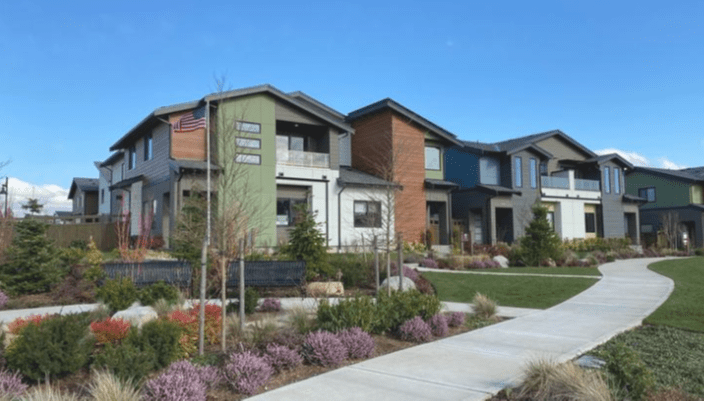

Housing developers and real estate experts say the Seattle market isn’t seeing an urban exodus so much as a “Covid shuffle.”
It’s a paradigm that's been longer in the making than the pandemic-driven economic disruption, as homebuyer priorities have drifted toward larger spaces, bigger yards and more privacy.
That’s created some breathing room in urban housing markets for new entrants and buyers who haven’t turned their backs on city living.
“I don’t think it’s the end of higher-density urban spaces, but there’s certainly a lot of demand pressure on small towns in rural areas and suburban areas that was not there prior to the pandemic,” said Whit Hammond, project manager at Bellevue-based real estate development firm Oakpointe. “It’s certainly benefiting homebuilders that were already in those spaces.”
Remote possibilities
The rise of virtual work opportunities that eliminate long commutes may help accelerate driving forces that were already well underway, said James Young, director of the Washington Center for Real Estate Research.
There's even a new term for it: Zoom towns. The ubiquity of virtual platforms like Zoom is prompting knowledge workers to flock to scenic places where they can live more cheaply and telecommute.
In November, the median price of single-family homes in Chelan County in central Washington rose 37% year over year, and Young said that reflects this trend. It's also unfolding in the central Puget Sound market. where the median sale price of homes rose 10.4% in King County but 15.6% in Kitsap County.
Frank Leach, broker/owner at Re/Max Platinum Services in Silverdale said new construction in Kitsap County is at an all-time high with numbers not seen since the 1990s, but that it's not keeping up with demand.
Zillow data released in August show an increase in home searches over the summer, but no change in the types of homes buyers preferred. Suburbssaw most of the growth in search traffic.
“We’ve had what I perceive as the ‘Covid shuffle,’ with buyers looking to make themselves comfortable in what appears to be the new norm: space to be outside, space to work from home, space to educate from home,” Hammond said.
That lines up with historic trends that show younger homebuyers often trade the urban experience for yards and space once they start a family, he added.
Single-family homes have appreciated faster in 2020, according to the Zillow report, but that trend predates Covid-19. Search activity increased for homes valued at more than $1 million. So did interest in new construction which — while still a small segment of overall sales — rose 83% year-over-year in June and 72% in July.
RECOMMENDED
For example, a new Issaquah master-planned neighborhood, the 63-home Panorama at Talus, has since mid-August seen nearly one sale per week, with prices between $1.7 million and $2.2 million.
Panorama homebuilder Dan Lungren of Lungren Homes said the goal is to start three or four homes every month, “and we’ve already sold more than half of those planned in our first phase.”
Metropolitan fatigue
For recent homebuyer James Moore, the decision to move out of Seattle had been years in the making. He and his husband, a surgeon, had lived in apartments and condos near the city center for about six years, close enough to their jobs that they didn’t need a car. But the benefits of city living couldn’t outweigh their desire for more space.
“Over time, it just kind of wore us down,” Moore said. "We could have the windows closed and we could still hear people screaming in the alleyway or the hum of cars on (Interstate 5). After a few years, it just broke us.”
By the time they were ready to buy, though, everything had changed. Touring homes meant wearing shoe covers and masks, and open houses had been replaced by 30-minute appointment windows.
Despite the restrictions, the couple closed quickly on a five-bedroom, two-bathroom home near Burien on a quarter-acre lot, coming in well under their $750,000 budget. Both still work outside the home, but set one room aside as an office space and hobby room.
“Everything I had thought home buying would be just didn’t materialize,” Moore said.
Homebuyers are able to capture more value for their dollar when their radius widens, Young said, rattling off locales like Mount Vernon, Tehaleh near Bonney Lake, Centralia and Shelton that have seen a spike in popularity.
“It seems that there’s some consensus that there will be more flexibility in how we work,” Hammond said. “For some of those buyers it gives them a longer leash in terms of where they can be relative to an office or an office hub.”
Rather than changing homebuyer behavior, the pandemic has sped up what was already in process, Young said.
“To the extent that developers can cater to that, it’s going to be guns blazing for a while here,” he said.
Demand is everywhere
Among Oakpointe’s projects is the Ten Trails master-planned community in Black Diamond, about 45 minutes southeast of Seattle. With building on many lots still underway, Ten Trails has around 500 units sold and a few hundred residents.
For those early buyers, demand for internet connectivity has supplanted concerns over their commute, Hammond said. Developers also haven’t been blind to the things buyers admire about about urban centers. New housing projects have sought to build in walkability, retail and dining, open space and a sense of community.
“You do have to look beyond these kind of black swan events,” Hammond said. “Developers have to think in decades if you want to bring a project like this to fruition.”
Meanwhile, the renewed enchantment with suburban living has created some breathing room in a housing market that had trapped some homeowners, said Rachel Adler, managing broker for RAREnorthwest. Many second-time buyers looking to cash in on equity they’d built up in their properties had previously found it impossible to get into a new home in the short window it took to make the sale.
“There have been times when the market was too strong and you weren’t able to take some of those risks,” she said. “They were just stuck, but that’s not the case this time.”
Now, it’s buyers in the $700,000-$900,000 price point that are feeling the pinch, often seeing another 10% to 15% added on by the time a property closes.
“If you’re right on that edge or stretching yourself to get to that price point, that’s where the challenges lie,” Adler said.
Her clients have been part of a small “migration” east of Seattle, putting a home gym and outdoor covered spaces at the top of their wishlists. That, coupled with interest rates at historic lows, has meant first-time homebuyers have also had a little more access, particularly if they’re willing to consider a smaller footprint.
“When you look at the downtown condo market, it’s actually the highest supply it’s been in years,” Adler said. “All pendulums swing.”
Between April and August, the inventory of condos in downtown Seattle rose from 154 to 340, but settled back to about 270 in November.
Yet many workers who have lost income due to the Covid-19 pandemic may now struggle to make payments on recent purchases or have to put homebuying plans on hold.
The perceived opportunity cost of not buying at low rates, coupled with high unemployment, will put a strain on the rental market in the coming months, Young said. Meanwhile, the uncertainty has some suburban owners deciding to stay put.
“You don’t see prices going down in any sector of the market,” he said.